
the new exploitation cinema
on Hamnet, the film

Here be spoilers. You have been warned.
I went to see Hamnet this week, and everyone but me in the cinema was crying at the end. Of course they were. The entire point of the film Hamnet is to get the audience to cry at the end. There is literally no other reason that the film Hamnet exists. It has nothing to say. It has no greater meaning. It has no depth. It has no politics. It has nothing but the intent to bring its audience to weeping. Isn’t it sad, when a child dies? it asks. Yes. Yes it is.
I have not read Hamnet, the book. I hear from people with great taste that it is wonderful. I can imagine that, in the hands of a novelist, this story is done very well. I don’t wish to besmirch the book at all here, because everything wrong with the film is the fault of the screenwriting and the directing. The script is excruciatingly bad. The directorial choices compound its awfulness. It has left me wanting to read the book, to see this story in the hands of someone better—because there is so much to this story, so much to explore, and the movie isn’t interested in any of it. All it is interested in is making the most obvious choice at every single turn, to most frictionlessly and thoughtlessly get us to our conclusion, in order to wrench emotion from the public. There is a reason that everyone who dislikes this film uses the same terms: cheap, hollow, shallow, exploitative, manipulative.
Of course, cinema is manipulative, exploitative. It plays with your emotions; with this I have no issue. You watch sad movies to cry. You watch funny movies to laugh. You watch Kubrick movies to have a complex existential reaction that you yourself can’t quite understand. But all these films—at least, the good, multifaceted ones—employ interesting filmmaking techniques, good writing, and complex characterisation to achieve their goals. Hamnet does not. It picks the most trite and overdone option over and over again, shows about no interest in its characters and lets them have no real interiority, and exists only to gets to its own conclusion. It is not just exploitative. It is an exploitation film.
When you think of exploitation cinema now, you primarily think of horror B-movies—the ‘video nasties’ of the early 80s, though their real heyday was the 70s, when grindhouse cinemas played movies replete with sex and violence, giving the audience exactly what they wanted with little getting in the way of that. These films were intended to shock the viewer, largely not bothering to mess about with such cinematic concerns as proper characterisation or a conceivable plotline or even realistic scene-setting. Great filmmakers did work within this genre—often getting their start within the low budgets and loose constraints of grindhouse—but it wasn’t necessary to be great. The artlessness was kind of the point.
As a film fan, exploitation movies are enormous fun, as they are designed to give space to content that falls outwith the more polite conventions of mainstream cinema, focusing often on youth culture, illegality, monsters and the taking down of oppressive systems. The myriad subgenres speak to the home different communities and interests found there: from the exploitation umbrella grew Blaxploitation cinema, giallo, Meiko Kaji’s entire career (specifically rape-revenge movies such as the incredible Female Prisoner 701: Scorpion) and both the zombie and cannibal strands of horror. Subsubgenres include sharksploitation and (my favourite) nunsploitation, which includes Ken Russell’s phenomenal and hysterical The Devils (more on this in future).
My point is that these films existed to exploit; they were aimed primarily at titillating the audience, providing them with salacious content to arouse their most base reactions, and growing popular because of this. Many did not pretend to be artful, but often achieved artfulness because the writers and directors were inherently skilled, and really gave a shit.
Exploitation, too, is the sole intention of Hamnet. It exists to make its audiences leave the cinema crying, and to say to their friends: you must go and see Hamnet. I was sobbing at the end. It, too, dispenses with such general filmmaking concerns as proper characterisation, real relationships or the existence of anything outside its primarily plotline. But it refuses to accept that this is what it is. Instead, it makes every attempt to convince you that it is a work of art, from its overwrought performances to its ludicrously-framed shots, all the way to its appalling use of some of the most enduring plays ever written. And the worst thing is that if you pay the slightest bit of attention to any of this, it even fails to achieve its own goal: that of making you cry.
Several years ago, in a conversation with my partner about the most heart-rending moments in cinema, I played the window scene from The Hours (which I am not linking here for reasons that will become clear momentarily). I cannot watch this scene without sobbing; I can barely even think about it without starting to cry. My partner was so unmoved by this scene, in isolation, that it brought about laughter, and the incongruity of our reactions gave rise to an argument that raised its head several times over a couple of months, resulting in the only time we have ever argued in front of friends (in retrospect, I can see that I was very hormonal and completely unreasonable here; we can now laugh about it. Just.)
The thing is that my partner didn’t get the emotional weight of that scene, in that moment, because we hadn’t watched the rest of the film. I had, so I was carrying with me the depth of their relationship, the horror that Ed Harris was suffering—all of it. The film had spent over an hour establishing all of this in great detail, including Meryl Streep’s deep inner turmoil, and so when the event occurred, it broke me. In Hamnet, when it reached its climax, I was completely unmoved, because it had failed, during its two hours, to establish anything like interiority or depth of relationship. I HAD seen the rest of the film, and still felt nothing. Because the sole intent of the film is to exploit, to arouse any normal person’s reaction to the death of a child (deep, deep sorrow), and yet the film does not earn what it is trying to achieve—despite being contrived to within an inch of its life from the very first scene.
From the moment we meet Agnes, sleeping in a forest, it is clear that the symbolism of nature is going to be shoved down our throats—and this, like everything else, will be linked in the final scene, when a production of Hamlet is inexplicably performed against a forest backdrop, despite very famously not being set in a forest (a change that is made only to refer to Agnes, thinly). Agnes meets Will; why are they drawn to each other? What are they looking for in another person, what do they want from their lives? Who knows. The film explains nothing about them beyond the broadest brush strokes. Nothing that cannot be called back later in the film—in either the climax or the race to get there—will be allowed. And everything that we need to know to reach that point will be laid out not through showing, but through a character telling us. Directly, and without a hint of nuance.
When William’s mother finds out Agnes is pregnant with his baby, she is not happy about it and she determines she will never consent to their union. We know this, because this is what she says:
You will need our consent and we will never give it, never!
But thanks to her own mother, Agnes knows what it is like to be properly loved. We know this, because this is what she says about her mother (to her brother, who presumably already knows):
Everyone is so afraid, Bartholomew. She never was. Because of her we know what it feels like to be properly loved.
William did not, however, know this. His father was a brute. And when he has his own child, Hamnet, William worries that the child’s grandfather will be violent towards him. We know, because this is what he says to Hamnet:
Yes...Listen, I want you to stay away from your grandfather. He’ll not hit your sisters but it’s you I worry for. I need to know you’ll be safe when I’m not here.
I could go on. There are such obvious ways to show all of these things without having the characters just directly say them. Rather than a cheap screaming match at the arrival of Agnes into the house, we could have seen something more sinister beneath the mother’s reaction; a slow look, a silent promise to herself that she would sabotage their love, a resting of her hand on her son’s arm. (In the end, none of this matters anyway, because the mother does, straight away, accept Agnes, and the film doesn’t bother to show us why or what her internal struggle to do so looked like. The argument was just to cause a cheap bit of tension for them to immediately overcome.)
Showing these things is ludicrously simple. It just takes a little bit of time—and I do mean a little bit. Just a few shots here and there. But that would require actual scenes. Hamnet is comprised of a series of incongruous half- or quarter-scenes designed to give you exactly enough to get to the climax, and not more. If something is not explicitly required to get to where it is going, it is cut. Some of these things, these themes and threads, are cut long before the end, because they have served their immediate plot-advancing utility. It is film-making by the worst sort of template, the director attempting to crack the award-winning, tear-jerking formula with both extreme austerity and apparent artfulness, which unfortunately cancel each other out, leaving you with shots and part-scenes that are desperate to be meaningful, but with nothing to actually express.
It is bad enough to have your characters (all your characters) just constantly saying exactly what they mean at all times—literally Bad Screenwriting 101. But it is even worse when these direct lines are all that the characters are. The film is so uninterested in actually letting us into the private worlds of its characters—so uninterested, actually in whether they have them at all, beyond the emotions required to land its big ending—that it relies on dialogue to do the work of characterisation. And it fails, because the dialogue is unbelievably bad, and is not supported by what the film actually shows.
‘You are a good man’ Agnes tells William, half an hour into the two-hour film. Is he? We’ve got no idea. We have not seen him make any moral choices, not seen him sacrifice anything for the sake of someone else, hardly seen him face any stress or tension at all. We have not seen him do anything other than write (what is he writing? Why is he writing? What does he seek from this writing? We have no clue) and violently respond to his father who is violent. Why is his father violent? Who cares! It is not important, says the movie.
‘I have to work!’ he says, in this same scene. But why? We have no idea what’s at stake. Is it money? Is it ambition or drive? Has he lost his other work? Or does he feel he has something he needs to express? Clarifying any of these would be the work of one single scene and the film simply cannot be bothered, because it does not care about its characters.
Worse still is when the dialogue attempts to characterise people and yet the film, more than not supporting these apparent characterisations, actually works against them. Let’s take Agnes. We are set up from moment one of the film to know that Agnes’s entire personality is nature and motherhood. We are told over and over again that Agnes will do anything to stop her children from dying, to keep them in the realm of the living. That she has the power of the forest within her, and knows things that others can’t know. Yet when her second, unexpected twin—the third of her children, Judith—is born lifeless, she does literally nothing about it. She accepts the death instantly. The midwife tries to remove the baby for burial, and Agnes takes it, but she does not actually attempt to save the baby’s life at all. Instead, she says a defiant line against the church (why? Christianity is basically invisible in this film, despite it being a major force in the lives of 16th Century folk) and her baby eventually starts breathing on her own. Agnes is completely passive in this moment, not attempting to apply the nature cures in which she supposedly believes. At one of the most important, character-defining moments of her life she is the opposite of what we’re told she is.
When Judith, and then Hamnet, grow ill a decade later, Agnes is active. We see her in full nature-mother mode. But when her nature cures fail her at the moment she needs them most, and leave her with a dead son, how does this affect her relationship with her beliefs? We will never know, because the film is simply not interested. Agnes’s belief in nature has served its purpose in terms of progressing the plot and so she never need think of it again. Her entire personality goes from Forest Witch to Grieving Mother, and the film is not even interested in how this switch occurs, or what it has done to Agnes, outside of having her exhibit the emotions it needs her to exhibit. There is no interiority of these characters outside of what they say explicitly, and what the plot progression requires. They are simply hollow.
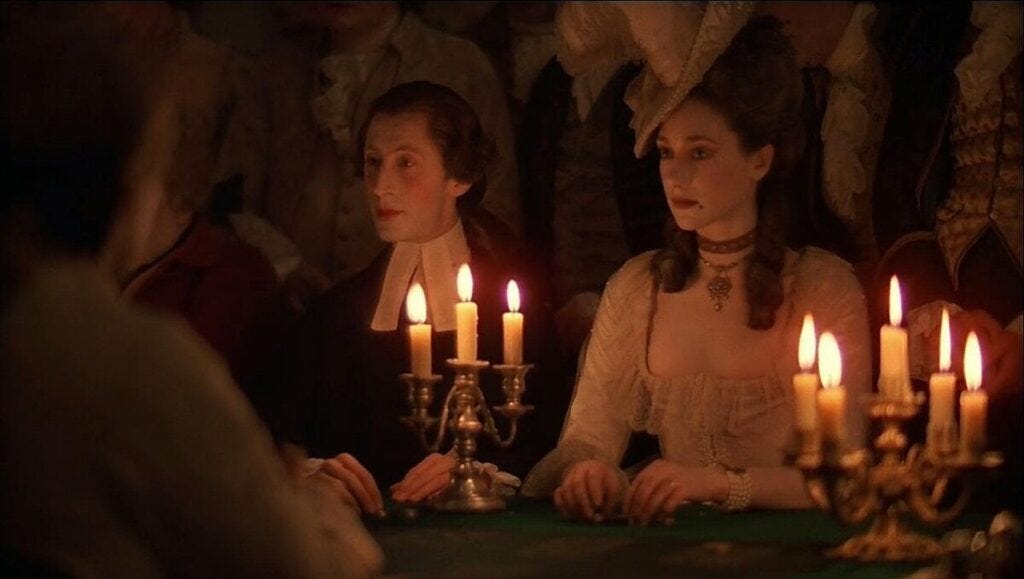
A moment here for a complaint that is broader than this film but absolutely applies to it: why can’t modern directors light darkness properly? Yes, we understand that it is nighttime. Yes, we understand that we are indoors. But we, the audience, still need to be able to fucking see what is going on. If the only way a filmmaker can convey low light is to actually have the light so low you cannot see the actor’s faces or anything else in the scene, when you need to be able to see the actor’s faces in order for the scene to be legible, then they are failing at the very fundamentals of filmmaking. This is basic stuff.
If Barry Lyndon can use predominantly natural light only, and still have night-time shots that are so well lit that the entire scene focuses on the minute changes in a character’s facial expressions, then directors working without those constraints should, at the very least, be able to show us what we need to be able to see. Several times in Hamnet I had literally no idea what was supposed to be happening on screen, what the characters were doing, because it was too fucking dark. This is a film that will almost certainly win every award going. What is happening to Hollywood?
About 70% of the way through the film, I thought to myself: is this right-wing propaganda? The film has no apparent politics. If you attempt to apply any sort of analysis to what is actually on the screen, what you’re left with is this: women are inherently bound to nature, and they procreate. Men are distant geniuses. Nothing exists outside the family home and work, even art, only matter when they can be tied to the domestic.
Its presentation of the children is, too, puzzling. Hamnet, as a character, has goals: he wishes to work in the theatre, with his father, to be a player in the way his father has taught him (swordfighting in the yard). He has challenges (he is asked to ‘be brave’ when William is away, although brave against what we have no clue, because the film fails to show us what Agnes goes through when William is away (despite insisting that Agnes, a 16th Century woman, would be aggrieved by her husband leaving for work)). What does their life consist of when he is gone? Who cares, the film says). What do the girls wish for? What are their challenges? Nothing. They feel nothing and they want nothing and they struggle against nothing. They are completely interchangeable from one another (so much so that my partner asked which girl was dying, at one point); all they do is learn about nature from their mother. Judith exists as a character because she is the catalyst for Hamnet dying, and nothing more. The best scene in the film is one in which the children put on a brief play for Agnes, directed by William, which is a hackneyed attempt to show where the ‘three witches’ of Macbeth come from, but is ultimately the only truly warm scene in the movie. What does this do for the children? How do they feel about William’s career and absences? Who knows. Who cares. We will get one shot of Hamnet crying because out of the children, he is the only one that gets a personality. But that is all.
At a stretch, given the way the ending plays out, we might say that the message of the film is that art is the thing that allows us to express ourselves fully. I certainly think this is what Chloe Zhao would say if she was asked to give the film’s meaning, in a nutshell. But the main issue with this is that people express themselves all too well in the Shakespeare family. They all have absolute emotional literacy (which everyone did in the 16th Century, of course, in the same way that they were all ‘gentle parenting’ back then) and they express what they feel directly. Apart from in a couple of scenes, on which this supposed meaning hangs.
At the beginning of the film, in their second meeting in fact—when William has already kissed Agnes, almost immediately, despite the film seeming to want us to believe he is shy—William says that he has trouble conversing with people. Agnes tells him to tell her a story, so in almost their first real interaction, he tells her the story of Orpheus and Eurydice. This is such bad, obvious writing that I let out my first massive sigh of the film, and thought: maybe I shouldn’t sit through the rest of this. But I wanted to trust.
Later, we see William struggling to write. He is at a loss for words about why he is struggling, because he is drunk. He refuses to let Agnes see what he is working on. He is tortured, in the usual extremely cliched way—but why? What is torturing him about the writing process? Why is he bothering, if it’s so hard? As an audience member you do not care, because you have no idea why he is writing, what he is trying to achieve, what might be in the lines he is putting together. We are given absolutely no indication as to what writing means for William Shakespeare—how it feels to him to write, why he keeps going with it, what he is trying to say with it. Agnes is completely uninterested in his passion; she does not seem to care once what her husband is actually doing, or whether or not he makes a success of it. She does not even seem to understand what a play is, at the climax—despite having watched her children perform for her earlier, and despite being married to, you know, William fucking Shakespeare.
But worse is the fact that the film doesn’t care, either. It only uses William’s writing career, his passion, insofar as it sets up the ending—and because the film thinks its focus is on Agnes, it pretends that her husband’s movements have next to no effect on the life of her or her children. But it doesn’t have the courage to make William a complete absence, which would have been interesting. It needs the Shakespeare hook (and it needs Paul Mescal, despite this being his worst performance to date), so it hedges its bets, badly. In the end, the film relies on two things: that you know he’s Shakespeare, so you understand that what he’s writing will eventually be considered works of genius, and that you believed the few seconds of the film where he said (and it didn’t show) that he struggles to communicate, and will infer that he is writing because he struggles to communicate otherwise. It is important that you think this, because otherwise the ending doesn’t really make sense. But the problem is that he doesn’t struggle to communicate the rest of the time. Not even around his grief. In fact, because everyone says exactly what they feel, and because this film progresses at a breakneck speed, this is what he’s said just minutes prior to the final scene, to Agnes:
I find that I am constantly wondering where he is. Where he has gone. Whatever I am doing, wherever I am, I am thinking: Where is he, where is he? He can’t have just vanished. He must be somewhere. All I have to do is find him. I look for him everywhere, in every street, in every crowd, in every audience. I may run mad with it. Even now, a year on.
We are supposed to believe he cannot express himself, because he said it at the beginning. But the film does not make this true. Again and again, the film-making choices completely fail to support what the characters say, so you are left with this strange incongruence, as a viewer, coupled with so many cliches that it becomes almost immediately tiresome. The most quietly egregious quarter-scene in the whole thing has William Shakespeare standing on the edge of a bridge, apparently suicidal (with no suggestion of this beforehand—whether it is his imagination or reality), reciting—and I am not kidding here—the start of the To Be or Not To Be soliloquy from Hamlet. At this point, I said, out loud: you’ve got to be fucking joking me.
This lack of care, this disdain for the audience, permeates everything in Hamnet. The film, as a whole, does not succeed in naturally bringing about the emotion it’s trying to ring from you, which is why it relies on hysterical performances that veer wildly between wide-mouthed awe and screaming, on the sheer horror of the concept of child death, and on the use of overused, trite musical cues—specifically the much discussed On the Nature of Daylight. According to Mark Kermode, it was Jessie Buckley herself who suggested this song, when they found that the end wasn’t working (a huge red flag), and Max Richter visited the set to find them not using the score he had actually written for the scene, but a twenty-year old composition that, as Richter told Zhao, had already been used to death. But its overuse proved its emotional resonance, and so in it went. And it succeeded: it was the music, not anything else, that made the audience cry. It is basically meme-ing you into emotion.
At the end of the movie, my partner said to me, ‘This is such an actor’s indulgence movie’. It is, but it’s worse than that: it’s a Hollywood indulgence movie. The script—the worst I have seen for a supposedly serious film—is a work of directorial indulgence, with enormous paragraphs of direction that read like bad romance novels. The painful dialogue gives actors exactly enough for them to hang awards-baiting performances on. The scene-setting is indulgent towards an apparent aesthetic at the expense of the audience actually being able to see what’s happening. The entire two hours is a race to get to the Big Emotional Scenes, to get to the question that will make any feeling human being cry, at the expense of the most basic characterisation and any kind of complexity or realism, and in taking this base path, it undermines itself completely. Yes, it is awful when a child dies. The worst possible thing. Yes, I should cry. And yet this film is so hollow, and these people I’m supposed to care about nothing but mere cut-outs of characters moved around on Chloe Zhao’s badly-lit stage in order to reach that final scene, that when it comes to the big moment at the climax, I felt nothing but annoyance.
You cannot make a supposedly human movie when you have total disregard for both your characters and your audience. And yet, it has already won all the Golden Globes and it will win all the Oscars. We are living in a world of extreme superficiality, in which people are desperate to feel something, anything real, and our films are starting to operate on this basis: meaningless superficiality that pulls all the necessary levers to make you cry, and nothing more. Exploitation cinema is back, but this time it’s pretending to be art.
Thanks for articulating what I was having trouble expressing. I went to see this movie with two other middle-aged women. I was expecting tears. The only 2 things I had heard in advance was that 1. Hamnet, a young boy, dies and 2. bring your tissues. However, we all left the theater dry-eyed. I then called my 30-year-old daughter, who also expressed her lack of emotional response to this movie. She was even more forthright stating" I really hated this movie". I was wondering, "What the hell is wrong with us?" Now, after reading this, I feel a little better. Interestingly, when I discussed this movie with a 60-year-old lawyer friend, most known for his baseball fandom, he told me he was a blubbering idiot. He said the film should have a warning label. I agree.
i’m so glad you wrote this because i’ve seen nothing but unanimous praise for this insipid bloody film 😭