
etiquette in Ithaca
a non-reactive, non-right-wing-coded film-watcher's review of The Odyssey

I fear I am gaining a reputation as a hater, so before I start, I wish to tell you that these are some new movies I’ve loved this year: No Other Choice; 28 Years Later: The Bone Temple; The Drama; A Private Life; Everybody to Kenmure Street; Blue Heron. I wrote about how much I loved The Mastermind here.
Let me confess that I have never read the Odyssey. I know very little about Greek epics in general, not through any sense of aversion but more through a lack of exposure. The discourse around the film’s production had largely passed me by. I honestly couldn’t care less about ‘historical accuracy’, or casting choices, or the fact that everyone is American; I don’t think you can expect anyone to fund a major Hollywood movie in Homeric Greek in 2026 (not in this economy!). It’s fine to translate things for a modern audience, as long as you do it well, and I believed that Christopher Nolan would do it well. I am an Oppenheimer apologist. I saw The Dark Knight four times in the cinema (I was very young). I cried at Interstellar. I remember very little about Inception, and think, all things considered, Memento is probably his best. All this to say: I was primed to like this movie, despite originally having next to no interest in it. The reviews had got me hyped.
The benefit of having almost no knowledge of source material and no skin in the game means that you can appraise a film as exactly that: a film that stands on its own. And this is how I approached The Odyssey, with my plastic glass of beer, my bag of chocolate covered nuts and my seat that leaned back: let’s watch a blockbuster. Within ten minutes of the opening shots, my partner and I looked at each other, paused, then both mouthed: oh no.
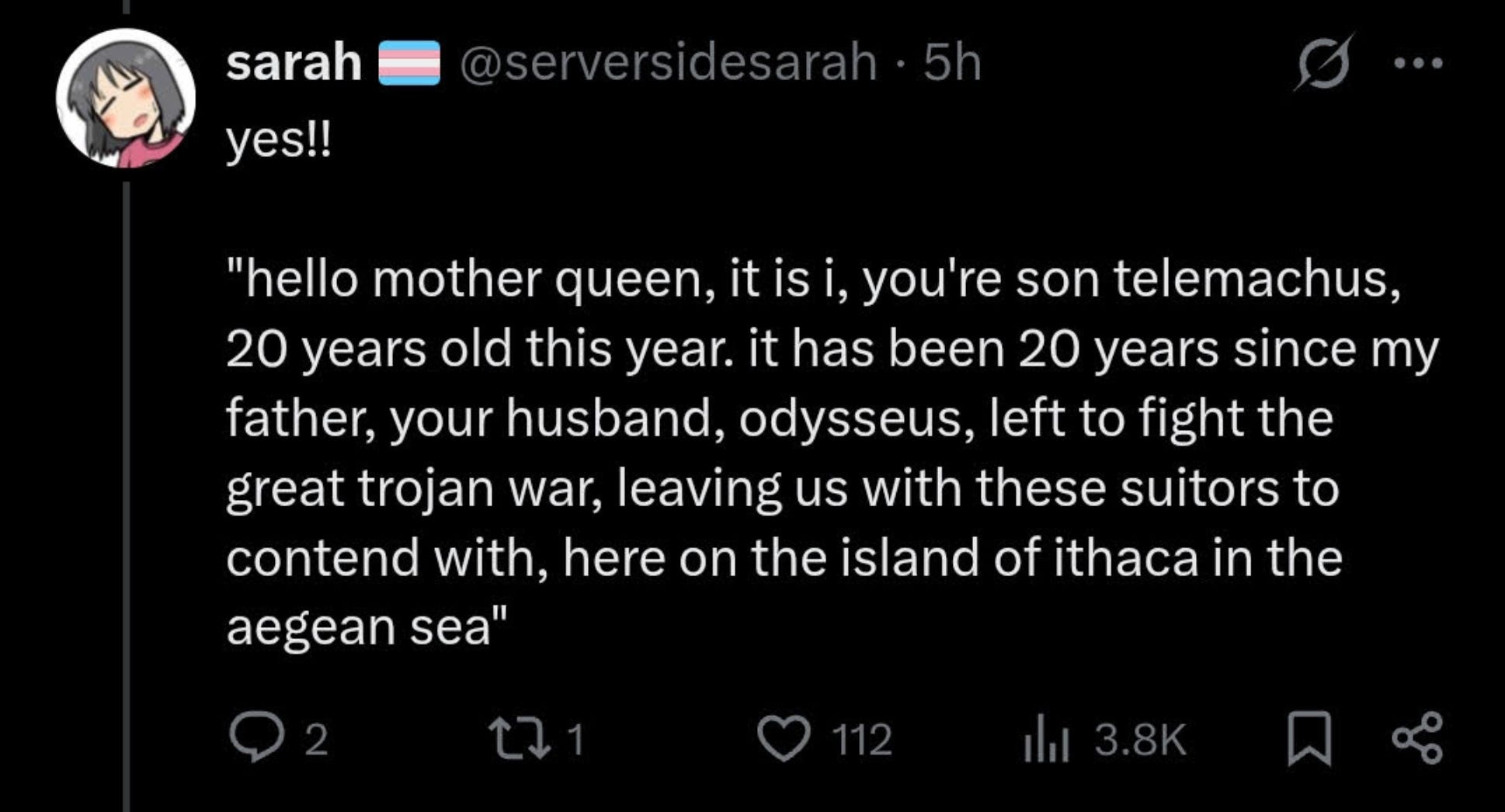
The major issue was obvious immediately: the script. Take the first exchange of dialogue between Odysseus’s wife and son:
Penelope: In this world, a man does what he chooses. I do what I can.
Telemachus: I am a man, now, Mom.
Ah, yes. THEME. I recall a time when Hollywood blockbusters employed writers, whose job it was to ensure that dialogue felt elegant and convincing, knowing that in the real world, very few people say exactly what they mean ever, if at all, and good dialogue should mirror that to some degree—even if the story is based on myth, even if it sits firmly within certain genre conventions. It does not necessarily have to feel correct to the time and place of the story’s setting—it is a form of translation, after all—but it should be coherent and subtle, as in it should feel, on some level, correct to how the humans on screen would speak to one another in the film’s world, instead of just outlining the Big Themes of the film in such a way that’s clip-able for social media. But then directors started to write their own movies, and all that went out of the window.
There is not a single line of dialogue in this film that isn’t completely on the nose, giving a chunk of exposition in the most perfunctory manner, or outlining the grand themes in the sort of stilted text you’d expect an LLM to spit out. Characters say only what the plot requires them to say, and not like people, but like characters in a movie, a classic Christopher Nolan issue. You might argue that this is mythology, so nothing is going to sound natural—but Nolan has translated the text into very modern speech, from which characters awkwardly shift into something more rigid. And in that inconsistent language he just has characters stating things, repeatedly. The same was true of Hamnet: just characters outright saying the thing over and over, no subtlety or nuance, just endless hours of faux-profundity to advance the plot and beat us over the head with THEME. This betrays a disdain for the audience; meaning has to be spelled out repeatedly, because we are apparently too stupid to glean it for ourselves. And this manifests as a cheapness, in visual as well as spoken language; there is a shot of a puppy flashback in The Odyssey that quite literally made me laugh out loud. As my friend Mingthoy put it, after seeing this film: we have entered the era of dialogue for TikTok audiences—and not just in blandly commercial movies. In films that will almost certainly win Oscars.
Dialogue is one issue; another is pacing. The film hops around from place to place and from time to time within those first ten minutes, so much so that it is difficult for the audience to orient itself, especially without a framework of knowing the Odyssey. But this is consistent throughout the film; scenes are rushed and contextless, because Nolan is trying to fit in so much, sometimes pointlessly, and in doing so he has sheared all the possibility of proper engagement with what he has chosen to include, or any sort of emotional reaction to it. He forces the film to move at a phenomenal speed, and this is achieved through a) not giving anything space to unfold naturally, and b) nauseating editing, something well discussed as a Nolan issue. It is worse in the first third than in the rest, but at some point in the first hour I actually began to time the cuts, because I was starting to feel like the editor was trying to induce a panic attack for no apparent reason; for a good amount of time there wasn’t a shot over 2.5 seconds long. At some points there was less than a single second between edits, and this isn’t in the middle of a climactic fight scene; we’re talking dialogue and set ups and flashbacks edited as if they’re Marvel action sequences. I have subsequently found a scene clipped online that has 22 cuts in 38 seconds, including a one-second cut to a flashback—in a two-hander conversation scene between Robert Pattinson and Tom Holland, containing information that is necessary for you to understand the unfolding plot, which it is difficult to take in, because the editing is so needless and jarring (and has the effect of highlighting Nolan’s habit of shooting every speaker in the dead centre of his frame, a very boring visual tic). You could mistake this for energetic filmmaking, but it is energy going nowhere, just burning itself up.
It feels insane to write that a $250 million movie by one of the world’s most heralded directors felt difficult to watch, but it seems that Nolan believes the audience will suffer any manner of experiential assault in order to get to his Here Is The Big Meaning portions. At the risk of sounding 104 years old, I must ask why Nolan insists on inflicting aural damage on the audiences for his pictures; the sound in his films is mixed in a way I can only describe as antisocial. For the first half an hour of The Odyssey I could only catch about a third of what the characters were saying, especially in the scenes in Ithaca when people were talking in rooms full of people; I understand there are many folk’s there, Chris, I can see them. Can you focus the mix on the dialogue I’m meant to hear? It is another classic Nolan problem that his actors don’t enunciate and he buries the dialogue in the mix, and here the issue is exacerbated by the lack of a traditional score; rather, the film has a bunch of monotonous soundscaping that peaks insanely loudly, so much so that I (and several other people at the Odeon) had my fingers in my ears at several points. This does not make for an absorbing cinematic experience.
The same can be said for the cinematography, which is supposed to be the film’s selling point. It was for this that I was really excited; I wanted to experience that sense of majesty that only an enormous film format can achieve, wanted to lose myself in wonderment at shots like this:
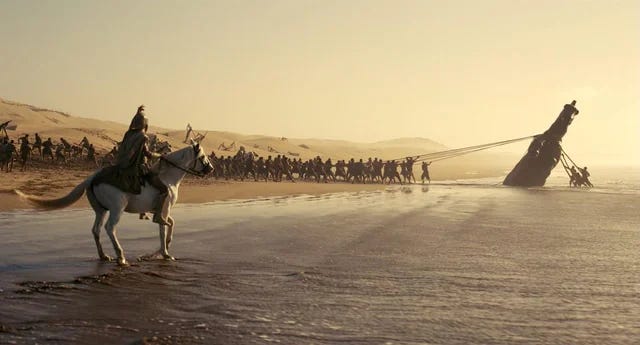
There were, it’s true, a lot of phenomenal images. Yes, it is absolutely impressive to shoot a movie like this on IMAX. I wish I had seen it at an IMAX theatre, because where it excels, it excels: the long shots of the beaches, for instance. But I never felt the grandeur that I expected, because all the beautiful shots are momentary, victims of the panicked editing. The limitations of the format also created one massive problem that Nolan could not get around, in low-light scenes especially: an extremely shallow depth of field. This is a technical issue and I don’t have a solution if you are committed to both IMAX and low light, but it feels kind of unconscionable, if you’re going to this effort, and spending all this money, to have several key moments at which the subject of a shot is actually out of focus. Not as an interesting use of visual language either; it is not used to situate something other than the speaker in the frame, it is just a technical limitation that works against the viewer being absorbed in the scene. This is another Nolan issue; he prioritises vibes over basic visual clarity, which is such an incongruous choice for a man who is otherwise acutely concerned with the look of his films that it always, always jars me right out of the experience. Here it is more egregious than ever; there were shot/reverse shot conversation scenes where neither speaker remained in focus, most notably a scene between Anne Hathaway and Tom Holland, which I felt like I was watching through a pair of binoculars. Robert Pattinson died in a blur, quite literally—at the climax of the film. Add in Nolan’s obsession with shaking cameras and ADHD editing, and you have, to my shock, a fairly terrible film-watching experience on the granular level, where you are sitting watching the most hyped movie of the year, but you can’t focus on the characters because the camera can’t either, and you’re overwhelmed with sheer noise, and when you do hear the dialogue, it’s dire. These are all things Nolan has chosen, but here is where the other experts should be allowed to step in and work their magic, when a director’s obsession with one technical matter causes major filmmaking issues that someone else should be allowed to bring up. Empower the screenwriters, empower the focus-pullers, empower the sound designers! Bring down the auteur supremacy!
But then—does anyone actually care? It seems not. The sheer bigness of the production appears to be enough for everyone else, and any response to the movie that is incongruent with this favourable mania is positioned as needlessly cruel or bitter, especially when it comes from a woman. What is actually on the screen, actually contained within the film, is seemingly less important than what people want it to contain. You are supposed to revere the ‘vision’ of the director, but not have any assessment of the detail of it, of its execution, as a viewer. I am afraid I cannot get on board with the idea that even-handed criticism of a quarter-of-a-billion-dollar movie made by a privately-educated multi-millionaire knight is some type of violence. I am not sure how we’ve come to the belief that reporting your own experience of seeing a film is an underhanded dig at the director, or that the only good-faith engagement with a movie is to sit there having no thoughts or feelings about it beyond bland positivity, because if you do engage critically with it at all, you have been ‘destroyed by online discourse’ rather than being a person with functioning senses and a brain who is invited, by dint of the work’s creation, to actually think about what it shows and what it means. I can only say that the combination of issues outlined above unfortunately torpedoed most of The Odyssey, for me—and for the friends I went with, huge fans of the source material.
In the last half it does improve, but by that point I was lost, as a captive audience member. Even the set pieces, the strongest parts of the film, failed to actually land. The Cyclops looked great, and I thought the face design was fascinating and different; the magic of practical effects. But I am told that this is supposed to be a horror scene; it did not work as such, because horror necessitates a lingering, requires time for the audience to feel the things you’re trying to make them feel. The Samantha Morton / Circe scene was probably the best in the film (and again showed the joy of old-school in-camera effects), but still moved at a breakneck speed. The shock of her quite literally moulding their physical bodies with her hands was excellent, and the visuals of them turning back: wonderful. But just flipping from set piece to set piece leaves everything unexplored, which is especially bewildering when there are significant repetitive elements. When dealing with such a large amount of source material, removing and amalgamating enormous parts of the story is necessary—so what was the point of including the Laestrygonians, given that the race of Cyclops could easily have been shown to destroy several boats, which was the only real result of the interaction with the Laestrygonians, except to once again impress upon us the THEME? We already get the extremely obvious point about Zeus’ law; we did not need this to understand it. As Odysseus’ men found the island, met them, and immediately bolted, my partner leaned over to me, laughing, and whispered:
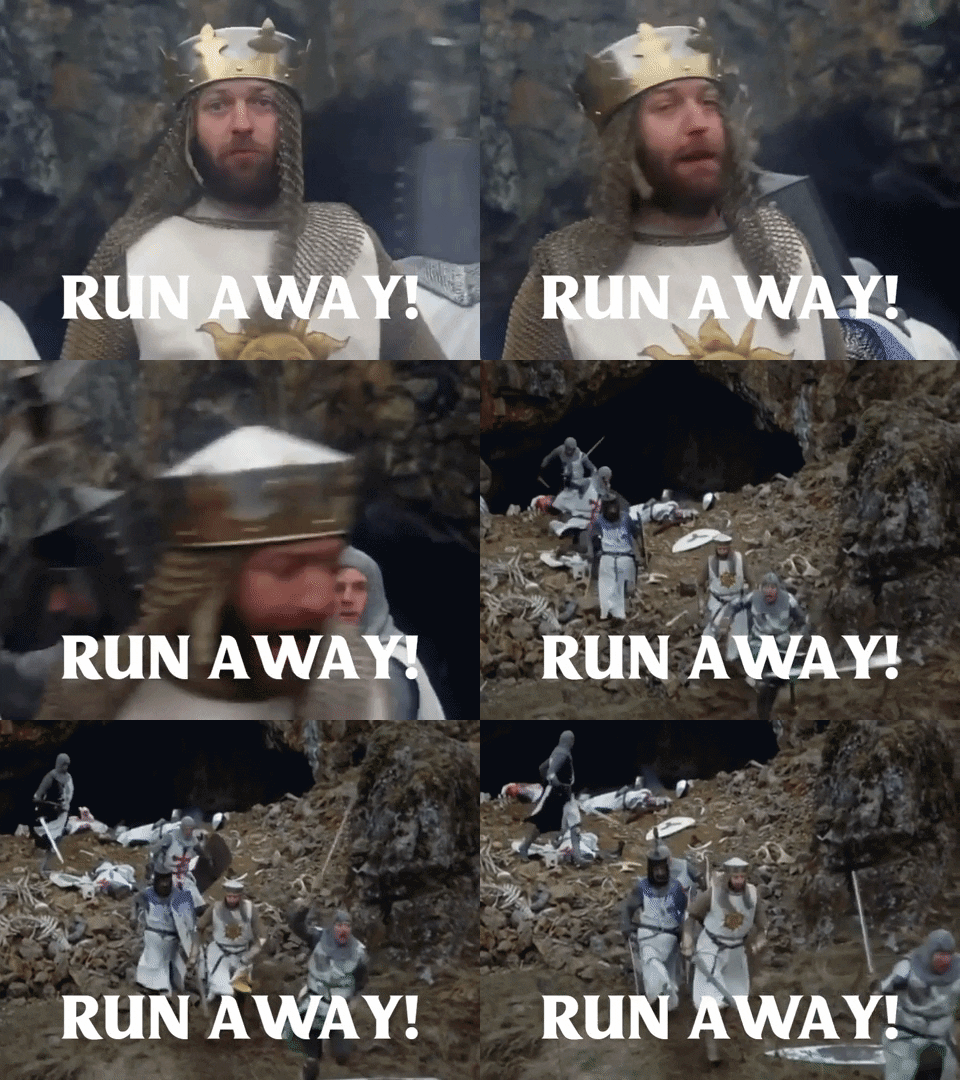
That needless scene could have been removed to allow us more time with Circe, who could then be better rendered as a complex character, rather than as a mouthpiece for a sort of thin, scolding contemporary revenge feminism—or to spend more time with the sirens, a scene that (as my partner pointed out) could have given us a magic and horror that unsettled the main quest, and instead was rushed through to give us even more ‘man sadness’. What if the version of himself that Odysseus heard in the siren song was a man of violent, warlike perversity, revealing that aspects of him truly enjoyed the sacking of Troy, the brutality, the murder? What if Nolan used this to deal with the near-certainty that Odysseus and his men engaged in sexual violence as an act of war, rather than hinting at it poorly with Circe? How challenging this would be to the viewer, and to our idea of Odysseus! Let us in to this world, Chris! Give us some magic, some depth, some horror, some time with SOME of this! Around the halfway mark it started to feel like a class from the worst yoga teacher at my gym: an unsatisfying series of too-fast movements that no one is actually doing properly, leaving you feeling like you’ve neither worked out nor relaxed. I sat in the cinema thinking: when am I supposed to start to feel something for any of these people? When am I supposed to feel awe, or terror, or grief on their behalf? As another friend said to me: not managing to conjure even one small moment of mystery or magic from this story is an achievement in itself.
Then, of course, there are the politics of it all, sexual and otherwise. For all its brief scatological insistence (where we must understand that the Greek soldiers are shitting and pissing all over each other inside the wooden horse), this is a strangely bloodless, sexless version of this story, all the base physicality shorn away in the service of Nolan making his grand points. Even in my ignorance I am aware that Calypso basically rapes Odysseus on a nightly basis for seven years after he washes up on her island; here their relationship is shown in the sort of cloying soft-focus romanticism usually reserved for lesbian sex scenes. Nolan won’t go near the idea of sexual violence actually being committed by the Greeks, because it would compromise his idea of Odysseus as a Troubled Hero marred only by his treatment of the Trojans. The Odysseus/Penelope relationship has no horn, even when he returns from two decades away, because Odysseus and his men are basically completely nulled; it is impressive, in a way, to make a movie this chaste and heterosexual about the ancient Greeks. But then, this is a translation of a story intended to avoid anything unpalatable to a modern audience, and by that I mean what major studio execs think audiences want: there must be no sex, no subtlety, and there must be no challenging morals—but there must also be a big superhero-style fight scene at the end via which our protagonist wins. And within all this there must be Nolan’s Message spelled out so clearly it cannot be missed. It is quite an experience to sit through a movie with very little knowledge of the source material and still understand that it’s been dumbed down. When Odysseus started on his intensely 21st century monologue about how awful their assault on Troy was, I began to roll my eyes. Yes, it’s about PTSD. Yes, it’s another Nolan post-9/11 analogy, lamenting the fact that The State of the World requires some ‘good men’ to turn bad. Yes, it’s about whether a great warrior, having sacrificed himself to the cause, can ever truly come home. All of this, again.
Much has been written about the inherent conservatism of the politics in Nolan's films, and I've largely thought of this as a bad faith interpretation of a guy who just likes big movies about big things; there was more nuance in Oppenheimer than many allowed for. But it is impossible not to notice, in Nolan’s The Odyssey, that the entire story centres around what is essentially a lack of manners in warfare, framed around ‘Zeus’ law’ (an extremely simplified version of xenia that we are also battered over the head with): you must welcome people into your home as if they might be gods, and you must honour the dead, and if you use these teachings to take advantage of your enemy, you have been made uncivilised. It is not that you should avoid killing; no, of course not. But your killing should be polite and honourable (under the threat of the vengeance of a god). The sin of the suitors is their boorishness and rudeness, the fact that they have overstayed their welcome; the sin of Odysseus is not that he fought a decade of war, murdering untold men (for the vast majority of deaths in this movie are given barely any credence), but that he used deception to gain the upper hand, then unleashed an unjustifiable brutality; it is that they went ‘too far’. The suitors will be punished by death for their sin, but despite his sin Odysseus will win out as the hero still, retaining his family’s prominence, plagued only by conscience. War destroys everything, the film tells us, but our ‘good guy’, no matter what he has done, must still emerge victorious, for he is the protector of civilisation. We are not supposed to question his divine right to rule; we are offered, instead, an apologetics for it. Yes, Nolan is working with a centuries-old text, but he has chosen this text, and in translating it, he takes responsibility of what it is made to mean to us, now. The film’s inescapable position, despite all its handwringing about the inhumanity of conflict, is that there is still a version of war that is fair and justified, as long as everyone plays by the rules, and to believe this we must discount the many (almost always the ‘underclass’) who are used as war fodder, used up and killed as their generals advance, then afterwards lament the effects of their actions. It is why the message of the ending seems to be that some men, no matter how corrupted, are born to hold absolute power, which should not be questioned by their subjects or enemies, and when a lack of respect is shown to these men their power must be regained through shows of strength and the mass murder of their impolite enemies. It is these men who are the ultimate victims, in Nolan’s view, made monstrous by the burden of power, and their punishment for it is being exiled from society; they must leave, with their riches, and ‘suffer’ elsewhere. The same for Odysseus as for Batman. The truly noble man, standing at the top of the hierarchy, must debase himself for the sake of society, and then be cast out from it.
We are left in a strange place when a director insists on inserting this moralism into a story about a triumphant, unrepentant warrior king; the Meaning, as forced down our throats, ends up feeling contradicted by the final portion of the film. Nolan has inserted modern morality into a story that cannot contain it without becoming thematically incoherent. We are also left in a strange place when all we’ve heard about the film’s production is that it is ‘woke’ (meant as a pejorative), but what’s actually shown in the film feels very different. The female characters, as ever, are poorly drawn and have little personal agency (despite some of them quite literally being gods). The extremely obvious symbolism gestures at a criticism of British/American aggression in West Asia, but this cannot harmonise with the rest of the story; at best it is a brief, superficial aesthetic, but it is completely at odds with the very bones of this narrative. With his enforced meaning, I am certain Nolan thinks he is making a liberal point about Trump and Farage, but what is the actual message in a 2026 context? It feels like a justification for the same types of conflict the West has waged for centuries, for the exact power structures we all labour under, but with the veneer of respectability that has been lost to ‘unpleasantness’, a pining for an imagined liberal lost age. It is uncomfortable, too, to sit in a country currently rancid with anti immigrant ‘protests’—in which asylum hotels are being set on fire by racist groups, Muslims are being attacked on the streets and the world’s richest man tweets constantly about ‘invaders’ with ‘morals antithetical to the West’ taking over, leading to actual Nazi salutes in our major cities—watching a supposedly progressive film in which ‘uncivilised outsiders’ move in to the ruling family’s home and take over, and the only means by which they can be removed is violence—when the household is so obviously meant to be read as a microcosm of society as a whole. Christopher Nolan cannot be held responsible for the rise of reactionary factions during a film’s production, and I don’t believe this messaging was his intent—but we cannot avoid the questions of how such factions have been empowered, what narratives have been weaponised to lead to their rise, or how supposedly liberal positions, and liberal wars, have marginalised, impoverished and demonised the global majority to the point that we are standing on the precipice of outright fascism. The reason there was so much discourse around this film before anyone had even seen it was that going back to Greek ur-myth, to one of the foundational texts of ‘Western Civilisation’, has unavoidably become shorthand for imperialist politics, an imaginary collectively shared by East India Company capitalists, Keynesian economists, Neoliberal acolytes, and the most naked forces of fascism, the latter of which are conveniently ignored by the collective former. For all Nolan's Odysseus's regret and reflection, he is still the person who must return Ithaca to its ‘traditional values’ via the mass murder of his enemies, must reinstall his family, the ‘legitimate’ ruling class, through a show of superhuman strength and ability. The only person for whom he will give up power is his son. All considered, The Odyssey feels like it has the politics of lawnmowing middle Englanders who don't like to think about the machinations of the British Empire and will stand on village streets to watch the Royal Family go to church, or Americans who make the Marvel franchise their entire identity. For a movie based on a philosophical, lyrical myth, it was distinctly unphilosophical, uncontemplative about the now, or how we have got to this position, and what progression might look like. This could have been a movie about a returning US Marine and it would have been functionally identical: a justification for absolute power as long as it is held politely, even when that power corrupts absolutely.
Friends have taken a very different message from this film, perhaps because they are more rooted in the source material, and bring so much more personal history to it. Certainly on social media, people’s insistence on what this movie means often supersedes, or is flatly contradicted by, what is actually shown in the film, to an alarming degree. This does not change my reading, but my interpretation is not, really, what made this movie a disappointment for me. I am also used to conservative politics in epic movies; lazy messaging doesn’t necessarily mean that a film is not good on its own terms, as a film. What kills this movie is a lack of filmmaking care, for which blame seems to lie equally with Nolan’s obsessions and Hollywood’s mechanisms, its insistence on giving us even apparently smart films dumbed down to the lowest possible common denominator, showing and telling us the same things over and over. I truly do appreciate a director in 2026 who commits to film, who commits to practical effects, who shoots on location and engages in the real act of making a movie. But the limitations created by this commitment, combined with Nolan’s particular tendencies towards editing, framing and direction (because there was some truly terrible acting, from one actor in particular), stopped me engaging with the story, pushing me away completely. And we cannot ignore the fact that the biggest films of this year have been exceptionally poorly written, and told in the most perfunctory, cynical way, nor that we are currently living in a cinematic reality where the world’s most well-paid actors are reading lines that might have been generated by LLM, acting in scenes edited for attention spans destroyed by social media. All while purported (but confused) meaning is rammed down our throats, because we are considered too stupid to understand even a hint of nuance. There is one good result of all this: that I am now desperate to read the Odyssey, to engage with this story in a languorous, absorbing way. But I went into The Odyssey wanting the Oppenheimer of the classics, and what I got instead was the Hamnet of Greek epics.
Since I wrote this, Odyssey translator and classicist Emily Wilson has reviewed the film from a much more informed perspective here, in the LRB, and comes to same of the same conclusions as above, much more eruditely. I highly recommend reading it.
He's a technical director, and by that I mean he's not mastered emotion, depth, or even just the mundanity of life in a frame. All the facets of human complexity take a backseat to the visual. Everything has to LOOK gorgeous, but it doesn't mean anything. He insists on writing too, and it's not a strength of his. That can only be ego. Very few can do both successfully. He's made a popcorn movie, and he's very good at making them. But there is nothing emotionally complex about what he does, and if you're looking for that, other projects will serve you better.
Wonderful review, thankyou.